Jeff Cargin, John Dwyer
The process for locating a site for Pennsylvania's Low-Level Radioactive Waste Disposal Facility (PALLRWDF) requires the use of a wide-ranging array of publicly available information obtained from a variety of agencies at the Federal, State, County and Municipal levels. In addition to data collection, the process also requires the dissemination of project information to the public. Although the earliest stages of the Project were performed at smaller scales, the standard base scale for the majority of the Project has been 1:24,000. This paper will discuss a number of the problems solved and lessons learned in using a Geographic Information System (GIS) to manage the spatial database necessary to perform a state-wide site screening at such a large scale. Among these are included: locating the agency that is the true source of the data being used; identifying and correcting mis-located data in an agency's database without validating the entire data set; processing very large GIS coverages; and making project information usable, understandable and accessible to the public.
1.0     INTRODUCTION


Federal law requires that each state be responsible for ensuring that

low-level radioactive waste generated within its borders is disposed of

safely.  A state may do this individually, or may combine their efforts

with those of other states and form a compact.  Pennsylvania, Maryland,

West Virginia and Delaware have joined to form the Appalachian Compact,

with Pennsylvania agreeing to site the first low-level radioactive waste

disposal facility for the Compact.  The screening process, designed to

locate a suitable site for the facility, is now underway.  Screening is

divided into two major portions: Disqualification (determining where in the

Commonwealth the facility cannot be located), followed by Evaluation

(determining where in the Commonwealth the facility should be located).

The Disqualification portion of the process, which was accomplished in

three stages (statewide, regional and local), has been completed, and the

first portion of Evaluation is underway.


The state-wide screening process for locating a site for Pennsylvania's

Low-Level Radioactive Waste Disposal Facility (PALLRWDF)  requires the use

of a wide-ranging array of publicly available information obtained from a

variety of agencies at the Federal, State, County and Municipal levels.

Although the earliest stages of Disqualification were performed at smaller

scales, the standard base scale for the Stage Three Disqualification and

Evaluation is 1:24,000.  In addition to data collection, the process also

requires the dissemination of project information to the public.  This

paper concentrates on the Disqualification portion of the siting process to

discuss a number of the problems solved and lessons learned in using a

Geographic Information System (GIS) to manage the spatial database

necessary to perform a state-wide site screening at such a large scale.

Among these are included: locating the agency that is the true source of

the data being used; identifying and correcting mis-located data in an

agency's database without validating the entire data set; processing very

large GIS coverages; and making project information usable, understandable

and accessible to the public.


2.0     DATA SOURCES


The siting process for the Pennsylvania Low-Level radioactive Waste

Disposal Facility has been an incredible learning experience from the

standpoint of GIS involvement.  The data requirements for a statewide

screening at a scale of 1:24,000 are onerous, involving a wide range of

topics and a similarly wide range of agencies.  The necessary data is

available somewhere in one form or another.  The trick is, identifying the

form and the source.


2.1     Who's got the Data?


An important consideration in gathering data for use on a large, multi-year

project such as the PALLRWDF Project is: what is the original source

agency for each data set used?  Although certain data sets are available

from many agencies, and while it may be very convenient to obtain some

data from an agency other than the source, there are still important

reasons for identifying the primary source agency for each data set, as

borne out by experience on this project.  Reason number one is: the source

agency actually generated the data, and so is most likely to be aware of

any limitations associated with a particular data set.  This information is

especially important in the planning stages of a project.  Many of our

first estimates of the amount and quality of data available for this

siting project came from agencies once or twice removed from the source,

and tended to overestimate the efficacy or availability of a given data

set.  For example, at the start of this project a number of years ago,

conversations with Soil Conservation Service (SCS) personnel indicated

that eight Pennsylvania counties had Soil Survey Geographic Database

(SSURGO) digital soils information available, with more to follow shortly.

However, further conversations with those at the SCS responsible for the

digital files indicated that this was not the case.  In fact, digital

linework for eight counties was just released in the fall of 1994, none

official SSURGO data, some four years after the initial conversations. The

lesson?  It may take four or five phone calls, but be persistent: the path

eventually leads back to the source.


A second reason for contacting the source agency is that it is aware of the

currency of the data, and can provide accurate information on the

availability of updates.  For example, the Federal Emergency Management

Agency (FEMA) provides a subscription service for Flood Insurance Rate

Maps (FIRM) showing 100-year floodplains (which are disqualified under the

PALLRWDF siting process) allowing the Project Team to receive updated

information on a regular basis.  Available updated information for the

different data layers has been used to set up a schedule for continued

disqualification, to be carried out in parallel with the Evaluation portion

of the process.  This dynamic approach to disqualification helps in

avoiding unpleasant surprises as the search narrows to three potentially

suitable sites.


A third reason for contacting the source agency is that the source agency

is also most likely to be aware of any changes in regulation or policy

that would affect the data.  A recent example involves the

disqualification of Exceptional Value Wetlands, which are in part defined

as wetlands containing threatened or endangered (T&E) species.  Recent

changes have been made to the Pennsylvania list of T&E species: some

species have been added to the list, and others have been removed.  This,

in turn, removes some wetlands from EV Wetland consideration, while adding

others.  LAW has been in continuous contact with both the Nature

Conservancy and the Western Conservancy, as well as with the State Bureau

of Forestry, which maintains the Pennsylvania Natural Diversity

Inventory.  As a result, we knew of the impending change well in advance,

and were able to incorporate the changes to the EV Wetlands

Disqualification coverage in a timely manner.


LAW has made an effort in each case to contact source agencies for each of

the thirty-five data layers involved in the three stages of

Disqualification.  These source agencies are listed in Table 1.

Maintaining a good working relationship with the source agencies over the

life of the project is also an important step in maintaining the currency

of the database.  LAW is fortunate in that the information used for this

project is considered publicly available information.  Therefore it is no

problem to provide the source agencies with any of the coverages we have

developed for this project using their data.  This value added data

exchange has allowed us to use original source maps from, and in return

provide boundary coverages to, a variety of state agencies, such as the

Bureau of Forestry, Bureau of Parks, and the Pa. Game Commission.


TABLE 1


Source Agencies By Disqualifying Criteria/Data Layer


Disqualifying (DQ) Criterion        Source Agency


DQ-01 Masking Facilities            US Environmental Protection Agency

                                    US Nuclear Regulatory Commission

                                    DER Bur. of Radiation Protection

                                    DER Bur. of Solid Waste Management

                                    DER Bur. of Water Quality Management


DQ-02 Active Faults                 PAGS


DQ-03 Geologic Stability            PAGS

                                    US Soil Conservation Service


DQ-04 Slope                         US Geological Survey


DQ-05 Carbonate Lithology           PAGS

                                    DER Bur. of Land and Water Conservation

                                    DER Bur. of Stormwater Management

                                    USGS Water Resources Division

                                    County Planning Commissions

                                    Pa. Dept. of Transportation

                                    Township Engineers/Managers

                                    County and Municipality Roads Dept.s


DQ-07 Coastal Floodplains           Federal Emergency Management Agency

                                    DER Bur. of Water Resources


DQ-08 Exceptional Value Wetlands    The Nature Conservancy

                                    Western Pa. Conservancy

                                    DER Bur. of Forestry

                                    US Dept. of the Int., Fish and Wildlife

                                    Pa. Fish and Boat Commission


DQ-09 Dam Inundation                DER Bur. of Dams and Waterway Mgment.

                                    US Army Corps of Engineers


DQ-10 Public Water Supply           DER Bur. of Water Supply and Community

                                    DER District Offices


DQ-11 Surface Water Intakes         DER Bur. of Water Supply and Community

                                    DER District Offices


DQ-12 Wildlife Area Boundaries

 - National Park Systems            US Dept. of the Int., Nat. Park Service

 - National Forests                 US Dept. of Agriculture, Forest Service

 - National Wildlife Refuges        US Dept. of the Int., Fish and Wildlife

 - National Fish Hatcheries         US Dept. of the Int., Fish and Wildlife

 - National Wild and Scenic Rivers  US Dept. of the Int., Nat. Park Service

 - National Wilderness Preservation US Dept. of the Int., Fish and Wildlife

   System                           US Dept. of Agriculture, Forest Service

 - Pa. Wild and Scenic Rivers       DER Bur. of Water Resources Management

 - Pa. Natural and Wild Areas       DER Bur. of Forestry


DQ-13 State Forests and Game Lands

 - State Forests                    DER Bur. of Forestry

 - State Game Lands                 Pa. Game Commission


DQ-14 Watersheds                    DER Bur. of Water Quality Management


DQ-15 Oil and Gas Areas

 - Gas Storage Areas                DER Bur. of Oil and Gas Management

 - Oil and Gas Fields               PAGS

 - Oil and Gas Wells                PAGS

                                    DER Bur. of Oil and Gas Management


DQ-16 Agricultural Land

 - Agricultural Security Areas      Pa. Dept. of Agriculture, Bur. of Farm

                                    County Ag. Land Preservation Boards

                                    County Planning Commissions

                                    County Assessor or Mapping Offices

                                    County Recorder of Deeds

 - Class I Soils                    US Soil Conservation Service


DQ-17 Mines                         DER Bur. of Mining and Reclamation

                                    DER Bur. of Abandoned Mine Reclamation

                                    PAGS

                                    US Geological Survey

                                    US Dept. of the Int., Bur. of Mines


DQ-18 Protected Area Boundaries

 - National Natural Landmarks       US Dept. of the Int., Nat. Park Service

 - National System of Trails        US Dept. of the Int., Nat. Park Service

 - National Historic Register       US Dept. of the Int., Nat. Park Service

 - Pa. State Park Systems           DER Bur. of State Parks

 - County Park Systems              County Governments

 - Municipal Park Systems           Pa. Dept. of Community Affairs

                                    Municipal Governments

 - Pa. Historic & Museum Commission Pa. Historic and Museum Commission

   Lands


NOTE: PAGS = Pa. DER Bureau of Topographic and Geologic Survey


2.2  What Format is the Data in, How Good is it, and When can I Have it?


Once the source agency for a given data set has been located, all your data

questions can be answered.  However, you should be prepared not to like

all the answers you receive. This is a period of transition in the move to

a digital universe, and many digital data sets are  almost there , or not

there at all.  During the past three years of this project, the majority of

the information received from the source agencies has been in the form of

maps.  Digital data sets have for the most part involved  point locations

for given features.


In requesting data, there are a number of considerations that must be

addressed.  The first is: what is the format of the data?  While there is

a tendency to react more favorably to digital data than to maps, in this

time of transition we have found that such a reaction can be premature.

One of our first experiences of   digital disappointment   involved the PA

Bureau of Forestry.  When we first contacted them for information on the

State Forest boundaries (State Forests are disqualified features), we were

informed that the National Forestry Service (NFS) had just digitized the

State s maps, and that we were welcome to use these digital files.

However, on close examination, these NFS files had not been digitized for

the same purpose nor to the same tolerance required by our project.  As a

result, it was easier to simply re-digitize the Bureau of Forestry maps

than to correct the digital file.  This example brings us to the next

consideration, locational control.


Just as locational control is not always available digitally, it is not

always available from maps. For example, during Stage Three

Disqualification, a 100-year floodplain disqualification coverage was

developed using FIRM maps.  However, many of these maps are not

georeferenced, and direct digitization was not appropriate.  At a

statewide scale, neither were detailed flood studies.  As a compromise,

the 100-year floodplains were delineated onto USGS 7.5-minute topographic

quadrangle maps, using visual control points (e.g. road intersections) and

base flood elevation lines if available.  These delineated floodplain

boundaries were then digitized to produce the 100-year floodplain

coverage.  This coverage carries a caveat: it is meant to represent the

100-year FEMA floodplains only for the purpose of siting the PALLRW

Disposal Facility; it is not a digital FIRM map.


There can be a difficulty with finding locational problems with publicly

available data on a project such as this is: how does one correct the

problem without the need to validate the entire data set? One approach is

given above: carefully prescribe the use of the data set, spelling out its

limitations. Another approach, the one we follow in most cases, is to

bring the problem to the attention of the source agency, and let them make

the correction.  A case in point on this project was Public Water

Supplies.


The PALLRW Disposal Facility may not be sited within 1/2-mile of a well or

spring used as a Public Water Supply.  In order to produce a Public Water

Supply disqualification coverage, we contacted the Department of

Environmental Resources (DER) Bureau of Water Supply and Community Health

and obtained a digital file containing point locations and identification

numbers (IDs) for the Public Water Supplies across the Commonwealth.  Upon

examination, we discovered that many of the Public Water Supplies lacked

location information.  In a joint cooperative effort, the sanitarians for

the various DER districts provided the missing locations.  (This is an

example of a  hole  in a data set; data sets must always be examined for,

and the source agency questioned about, such weak links).  A point

coverage was made of the Public Water Supply data, and the coverage was

examined for errors.  On the first pass, several Public Water Supplies were

located outside the Commonwealth, and were obvious mis-locations.  The

Public Water Supply locations were then compared to the county code that

was part of their ID.  Again, it was found that there were wells that were

not located in the same county as indicated by their ID.  These sets of

mis- located wells were again submitted to the Bureau of Water Supply and

Community Health, and the sanitarians in the appropriate DER districts

provided location corrections.  The result of this exercise is that we

were able to use a corrected data set that was publicly available and

still provided by the source agency.


2.3     A Cautionary Tale


In some cases the search for data sources can be compared to the search for

El Dorado: at each village (department) you come to, the villagers

(technical personnel) and village elders (department heads) know of the

golden city (digital map/database), and although they themselves have

never seen it, they know of someone in the next village (some other

department) who has.  However, at the end of the quest, after many such

encounters in many such villages,  what was seen from a distance as a

golden city, when viewed up close turns out to be simply the sun shining on

adobe huts (you can fill in your favorite analogy here: paper maps/lists

that never were made digital; AutoCAD drawings in table inches with

indifferent layering and linework;  digital data that "can't be officially

released until it undergoes full agency review"; etc).  The two-fold point

of this little tale is that, before you plan an expedition (or project)

where you're relying on outside data sources: a) make sure you're talking

to the primary source of the data; and b) find out in detail how good the

data is.


3.0     USING LARGE DATA SETS


A siting project as large as the PALLRW disposal facility siting project,

involving a state-wide screening at a scale of 1:24,000, can put a severe

strain on available GIS resources.  Many of the problems faced and

surmounted on this project have derived from the sheer volume of  data.

In this section we review some of these problems and solutions.


3.1     Keeping Track of Large Data Sets


While the project team attempts to use data that is already available in

digital format whenever possible, the primary means of entering spatial

data into the GIS is manual digitizing.  It is estimated that over 33,000

individual source maps have been digitized to date on the project.  At one

point, nearly 60 digitizers in 13 different offices across the country were

digitizing maps for input into the GIS.  Each of these digitized maps

additionally has an associated checkplot and coverage tracking forms.  In

order to efficiently handle such large volumes of work and paper, specific

Quality Assurance (QA) procedures were developed, not only for performing

the digitizing work itself, but also for the preparation and transmittal

of maps to and from the digitizing staff, and for handling the inevitable

errors and omissions that crop up after the work has been processed.  It

is these procedures that make processing such large amounts of data in a

timely fashion possible.


A great deal of effort was put into developing a set of procedures that

could be used to standardize digitizing tasks and allow for efficient

digitizing while still meeting the project's quality standards. Two

digitizing procedures were developed, one for ArcInfo and one for AutoCAD.

The QA procedures ensured that the digital files received from one

digitizer would be identical in format to those received from another, and

allowed the conversion process from digitized files to completed coverages

to be automated using AML.


Considering the number of maps being digitized, and the amount of

associated paperwork, it is clear that the process for preparing and

transmitting source maps is as crucial to project quality control as

digitizing procedures (it always helps to know that you got back as many

maps as you sent out, and that all of them have been properly processed).

Under the current data tracking procedure, as the delineators complete the

identification of disqualified features, the delineated maps are grouped

into a logical collection of maps referred to as a batch.  Once a group of

maps is placed into a batch, they remain together as a batch for the

remainder of the project.  Each batch is assigned a unique identification

number, and a tracking form is associated with each batch to track its

progress through the digitizing and coverage building process.  A batch

checkplot also helps to ensure that the entire batch has been properly

processed.


The automation of the digitizing and coverage building process, combined

with the detailed data tracking provided by the batch processing, has

enabled the project team to efficiently manage extremely large volumes of

maps and optimize staff resources.  This efficient approach to data

management has been proven to be a key component of the siting process.


3.2     Avoiding Unnecessary Work


One method of dealing with large numbers of large data sets in a timely

manner is to use data sets that are already in the system  to reduce the

level of effort involved for those that have yet to be entered.   This

philosophy has been followed wherever possible on this project.


The most obvious use for previously entered data layers is to tell us where

not to look for data.  While some of the data collected during

Disqualification are represented as points or lines, the vast majority are

area features represented as polygons.  A key characteristic of the

disqualification process is that once an area has been disqualified by any

given feature, it remains disqualified. This means that once an area has

been disqualified by a particular feature, that area no longer needs to be

investigated for the presence of other disqualifying features from other

criteria.  The GIS is perfectly suited to take advantage of this component

of the project.


Because the GIS has the ability to produce plots at any scale, LAW

developed a technique early in the disqualification process to produce

maps of previously identified disqualified areas which could be overlaid

onto a source map which was being delineated for a new disqualifying

feature. These plots, referred to as DQ Overlays, allowed staff members

delineating new features to determine which areas had already been

identified as disqualified, and therefore did not require delineation for

the new feature.


While quad-scale plots are the most common DQ Overlays produced, the GIS is

often used to produce overlays at a number of different scales, such as

county or municipality scales.  Many times, the exact scale or projection

of the source map cannot be determined, or the source map is not

georeferenced, which makes producing a matching DQ overlay difficult.  To

circumvent this problem, it is often possible to add geographic

references, such as roads, streams or political boundaries, to the DQ

plot, while not actually used as overlays, these plots aid in helping the

delineators to identify which areas on the source map have been previously

identified as disqualified, and can therefore be avoided during the

current delineation effort.


A second way of using previously entered data layers is to combine several

of them to produce a new data layer, thereby saving effort in delineation

and digitizing.  An example of this is the development of the Exceptional

Value (EV) Wetland data layer.  EV Wetlands are wetlands that intersect or

are wholly contained within certain features specified in the regulations,

such as National Natural Landmarks or Threatened or Endangered Species.

The PALLRW disposal facility may not be placed within 1/2 mile of an EV

Wetland.  Digital data were already available for these specified

features, most of which were Disqualification features for the purposes of

the PALLRW disposal facility siting.  National Wetland Inventory (NWI)

maps were used  together with plots of the specified features to identify

and delineate the EV Wetlands, which were then digitized and buffered by

1/2-mile.  However, for approximately one-third of the Commonwealth,

digital NWI were available.  An ArcInfo AML was therefore developed to

take the digital NWI maps, use the specified feature coverages to select

out the EV Wetlands, and then buffer them 1/2-mile and combine them to

produce an EV Wetlands coverage.  This use of previously available data

turned months of labor-intensive effort into weeks of CPU time.


3.3  Putting It All Together


One of the more challenging aspects of the disqualification process was the

preparation of a single composite disqualification coverage that

incorporated each of the individual DQ data layers.  From a theoretical

point of view, this would appear to be a relatively routine operation - the

polygon coverages would be unioned together in pairs until eventually all

disqualified areas were unioned together into one composite coverage.

However, due to the immense size of some of the individual data layer

coverages and the size limitations inherent to ArcInfo Version 6, which

was the version in place at the time, this became a rather involved task.


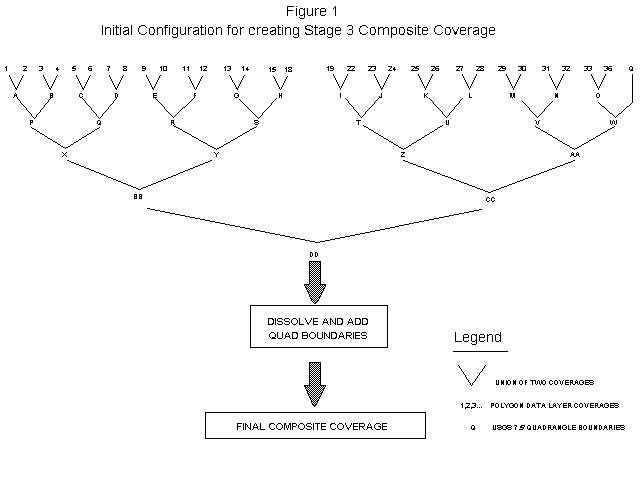
The initial unioning scheme for combining the 30 disqualification coverages

with polygon features is illustrated in Figure 1; however, because of the

10,000 arcs per polygon limitation present in the software at that time,

it quickly became apparent that this method of joining the coverages would

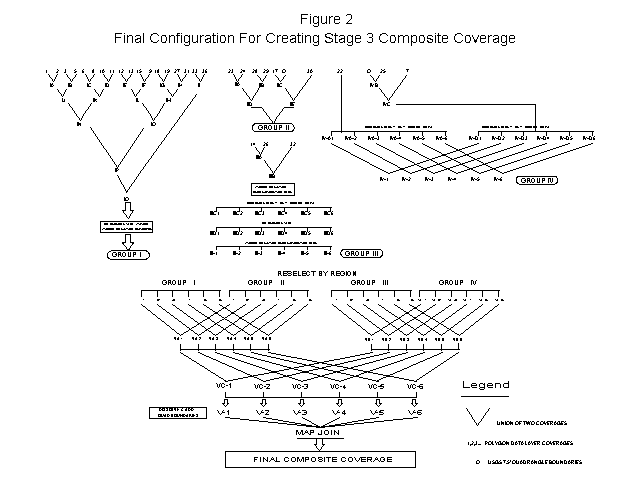
not be feasible.  Therefore, as an alternative, the coverages were

subdivided into groups of coverages which contained substantial overlap

between features.  The groups were selected strategically to allow the

composites to be dissolved at various stages of the unioning process,

which reduced the size of the coverage to a manageable level.
Even with the careful ordering of unions and successful dissolves, however,

the dissolved group coverages still proved to be too large to combine due

to size limitations of the software. Therefore, the coverages were

subdivided into six regional coverages corresponding to the six

Pennsylvania DER region boundaries.  This subdivision allowed the

coverages to dissolve properly and become as small as possible;  however,

the dissolved regional coverages still contained polygons too large to

combine back into an entire statewide coverage.  To circumvent this

problem, 7.5-minute quadrangle boundaries were unioned into each of the

dissolved regional coverages.  This caused the large polygons in the

dissolved coverages to be split into smaller, quad sized polygons.  Once

this step was performed it was possible to join the six regional coverages

together into a single composite coverage.  The final process used to

combine the 30 coverages is illustrated in Figure 2.  Even with this

technique, however, the size of the final Stage Three disqualification

coverage was well over 100 MB, with a total of over 100,000 polygons.
As a final note, we mention that, while the 10,000 arcs-per-polygon

limitation has since been removed in ArcInfo Version 7, ostensibly

removing our combinatory problems at the same time, the unioning of such

large coverages can still be difficult due to significant disk space

requirements.  When problems such as this arise, the methods discussed

above can still be effective in combining large coverages.


4.0     GETTING DATA TO THE PUBLIC


There is a two-fold purpose to the distribution of information from this

Project to the public.  The first purpose is to keep the public informed

on the progress of the siting process itself.  The GIS, with its ability

to easily create themed maps, plays an essential role in this effort.   The

second purpose is to disseminate to the public, for their use, the GIS

databases collected and generated by this Project.  Since the Project is

funded through the Commonwealth, the information collected is treated as

public domain data.  As each of the individual portions of the Project is

completed, as, for example, in the case of each of the three stages of

Disqualification,  the digital GIS coverages are made available to the

public, as well.


4.1      Maps


As each portion of the Project has been completed, a series of public

meetings have been held at various locations throughout the Commonwealth.

To date, public meetings have been held at the completion of each of the

Stages of Disqualification: Stage One, in November of 1991; Stage Two, in

February of 1993; and, most recently, Stage Three, in May of 1994.  The

Stage Three public meetings involved an extensive map production effort.

For each of the Stages a series of maps were produced which illustrated

the disqualification process at the appropriate scale.


For Stage One, maps were produced at a statewide scale of 1:750,000.  On

one, each individual disqualification criterion was plotted in a different

color, and on the second, each was plotted in the same shade.  Between the

two maps the public could visualize which areas of the state were

identified as disqualified and which particular disqualifiers eliminated

the most area in different regions of the state.  At this point

approximately 23 percent of the Commonwealth had been identified as

disqualified.  For Stage Two, the statewide maps were again produced, but

this time the same information was also produced for each of the six DER

regions at a scale of 1:400,000. At the end of Stage Two, approximately 46

percent of the Commonwealth had been identified as disqualified.


It was in Stage Three that the fullest use was made of the capabilities of

the GIS.  The Statewide and Regional maps were again produced,as they had

been for Stages One and Two.  However, Stage Three represented the last

full Stage of the disqualification effort (although, as explained above,

disqualification layers will continue to be updated throughout the siting

effort).  At this point, 75 percent of the Commonwealth had been

identified as disqualified, and the remaining portion of the Commonwealth

was to pass on to the Evaluation portion of the siting process.  It was

understood that public interest would be more intense at this stage than

for the previous two stages, and that the question most likely to be asked

would be "Am I disqualified?".


As a result, a 1:150,000 scale series was prepared for each of the 67

counties in the state.  These maps showed the composite disqualified areas

in gray, but also added local features such as roads, streams, and USGS

7.5-minute quadrangle boundaries.  These maps allowed the members of the

public to generally locate themselves within a county, and, if they

required further information, to identify which specific USGS quadrangle

they were interested in.  This further information was available because

the Project team had prepared each of the 909 quadrangles in the state at a

scale of 1:24,000, which is the scale of the Stage Three data.  These maps

included the disqualified areas in gray, as well as the roads, streams,

and municipal boundaries.  Using these maps, members of the public were

able to find the precise location in which they were interested, and

determine for themselves whether or not it had been disqualified.


The project team continues to receive requests for maps even now at a rate

of approximately 15 to 20 maps per week.  It is estimated that over 10,000

original maps have been produced and submitted to various public agencies

and citizens since the completion of Stage Three Disqualification.  The

ability to disseminate Project information at this level of detail is an

important element in developing public trust, and it is an ability that is

not available without the use of GIS.  The project team has received

numerous compliments on the clarity and usefulness of the display maps

from members of the public, including those who may have been opposed to

the project in general but still appreciated the level of effort put forth

to present the project information in an understandable manner.


4.2     Digital data


As was mentioned earlier, a good deal of the data that has been collected

and processed for this Project has never before been in digital form.  For

this reason, there has been a great deal of interest from both inside and

outside of DER to obtain this data.  As a result of this interest, it has

been a Project practice to provide to DER the digital coverages for each of

the Disqualification stages at the completion of that particular Stage.

The DER Bureau of Information Systems (BIS) disseminates the coverages

throughout the DER.  In addition, the Project team also processes requests

for data received from outside agencies through the DER Bureau of Radiation

Protection (BRP), which oversees the PALLRWDF project.


The coverages developed for this Project do have limitations.  It was

determined at an early point in the Project that the desired end was to

site a facility, not to develop databases for the Commonwealth.  The

information important to the Project is whether or not an area is

disqualified; as a result, the coverages produced during disqualification,

while having excellent boundary information, do not contain a great deal

of attribute information (although each of the coverages contain extensive

documentation).  In addition, since the use of DQ Overlays, as described

above, were prevalent in Stage Three, not all of the Stage Three coverages

are complete for the entire Commonwealth.  Even with these stated

limitations, however, the coverages have still provided a GIS jump-start

to a number of agencies, and are receiving extensive use throughout the

Commonwealth.


ACKNOWLEDGEMENT


The authors wish to acknowledge the management and staff of Chem-Nuclear

Systems, Inc., for their cooperation and support in the production of this

paper, and throughout the entire GIS siting effort.