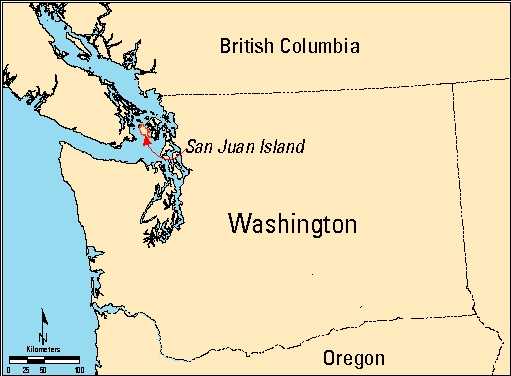
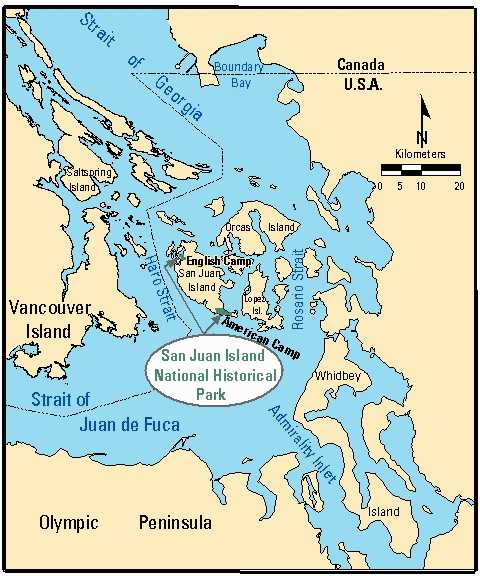
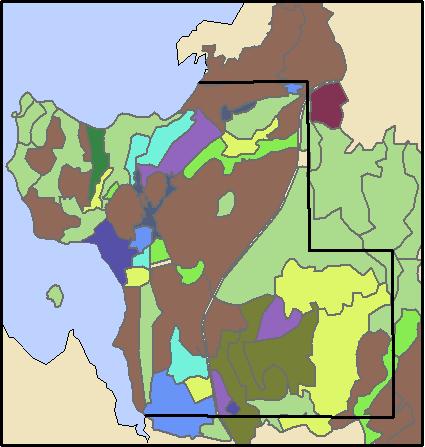
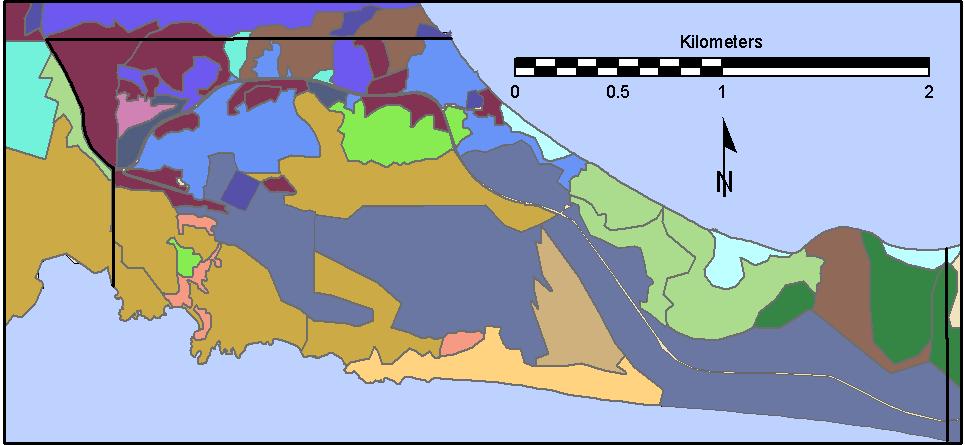
Abstract: We are developing geodatabases of vegetation and fuels for San Juan Island Historical Park using field-based classification and data collection.This will provide park managers with a valuable database relevant to scientific and managerial applications.We outlined patches on color DOQs, using color and texture clues in the imagery.We then conducted sampling in the field, touring all of each patch and revising boundaries as necessary.Because the park is only 715 hectares, we are able to achieve essentially 100% coverage.Allocation of heterogeneous patches to combinations of fuel models and community types led to some interesting cartographic results.
A key to management of vegetative resources at the park is knowing their current distribution and abundance and having a database available as a GIS coverage.An excellent description of the forested plant communities of the park was developed by Agee (1987), including some description of potential vegetation (through successional time), fuel characteristics, and limited geographic distribution.The scientific context for further analysis of vegetation and fuels at the park is provided by Agee (1984, 1987), National Park Service (1984), and Rolph and Agee (1993). The current project is to develop a geographically accurate and detailed map of vegetation and fuels for the park.
Because the park is located on a desirable island and has many vacation homes abutting the park boundaries, the park has a keen interest in understanding how wildland fires might behave in the park.The fuels component of this work will enable the park to run fire modeling software to understand potential fire behaviour.
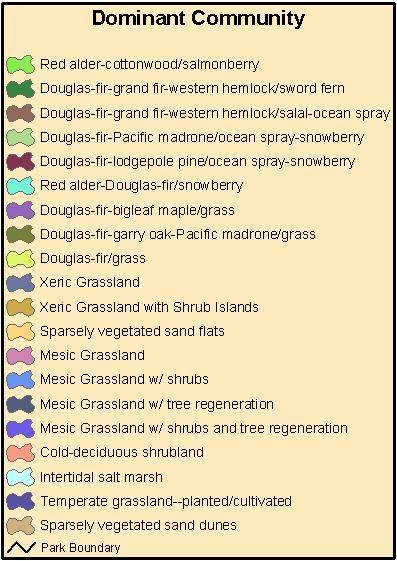
Vegetation was classified according to Agee (1987) and FGDC (1997).Agee's system consists of 11 plant communities relevant to the forested areas that dominate the park.These forest communities are based on empirical data and subsequent analysis that confirms the robustness of the individual communities as discrete entities.This classification provided an accurate representation of the forest composition of the park in terms of species dominance.
Data collected for each patch included an exhaustive species list for both overstory and understory plants, a tree survey, forest community, fuel model, ground fuels, and characteristics essential to calculating crown fuels.
Data from the field work was entered into a database.The field data was manipulated to produce statistics for each patch. For patches with more than one plot, data were averaged from the different plots. Stem count and basal area for each patch were derived from the tree survey. Number of communities per patch, number of fuel models, number of understory and overstory species, dominant fuel model and dominant community for each patch were determined from patch characteristics.Crown bulk density for each patch was determined from the modal tree and tree survey. Fuel loadings for each patch were determined from the ground fuels data.This provides the fuel variables necessary to run FARSITE (Finney 1998), which simulates the spatial and temporal spread and behavior of fire. We also developed a crosswalk from the Agee (1987) community system to the National Vegetation Classification System (NVCS) (FGDC 1997, USGS 1997) to meet the Department of Interior requirement that vegetation mapping use the NVCS.
Agee, J.K. 1984. Historic landscapes of San Juan Island National Historical Park. Report CPSU/UW 84-2. National Park Service, Seattle.
Agee, J.K. 1987. The forests of San Juan Island National Historical Park. Report CPSU/UW 88-1. National Park Service, Seattle.
FGDC. 1997. National vegetation classification standard, FGDC-STD-005. USGS Federal Geographic Data Committee, Reston, VA.
Finney, M.A. 1998. FARSITE: Fire Area Spread Simulator, model development and evaluation. USDA Forest Service Research Paper RMRS-RP-4.
National Park Service. 1984. Rabbits, redoubts, and royal marines. National Park Service, Seattle.
Rolph, D.N. and J.K. Agee. 1993. A vegetation management plan for the San Juan Island National Historical Park. Technical Report NPS/PNRUW/NRTR-93/02. National Park Service, Seattle.
USGS. 1997. The USGS-NPS Vegetation Mapping Program. Online document at http://biology.usgs.gov/npsveg.