
Information about facilities is central to the business operations of every organization. An enterprise-wide approach makes facilities data available to information systems and databases throughout an organization to support decision making in each business unit. Enterprise solutions require thoughtful planning, design and resource management. Successfully implemented, they return higher ROI because of the breadth of issues they support.
This session will discuss and demonstrate the successful integration of ArcView GIS as an enterprise-wide space management system to manage facility assets valued in excess of $3 billion spanning 24 million square feet at the University of Minnesota.
This paper takes a look at the enterprise-wide space management system implemented for the University of Minnesota by the Jordani Consulting Group (JCG). It begins with discussing the challenges of space management and the importance of defining a spatial model for facilities information. GIS software is then examined as a strategy for meeting the needs of facilities managers. The implementation at the University of Minnesota is discussed next, stepping through each phase of implementation.
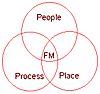
Facilities Management is a discipline defined in the 1970's by the Facilities Management Institute to encompass the management of people, process and place. Effective facilities operations is the responsibility of facilities managers (FM), whose daily tasks may include long and short-term facility planning, financial forecasting, real estate acquisition, interior, architectural and engineering planning, maintenance and operations, telecommunications and security.
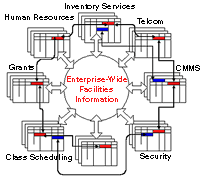
Information about facilities is used to support a number of other business processes such as maintenance and operations, real estate/property, human resources, capital planning, inventory services and information services. By implementing a consistent spatial model from the facilities information, relationships can be developed among these business processes that could not be achieved previously. For example, a common spatial reference of "office number" in both human resource data (personnel name, position and office number) and in maintenance management data (equipment name, service call, service date and office number) allows correlation of personnel to equipment and service calls . This spatial reference provides a consistent vocabulary for locating facility assets and enables business analysis to cross departmental boundaries.
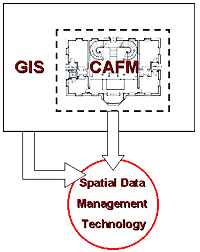 Computer-Aided Facilities Management (CAFM) systems are widely used by facility managers for space management. CAFM integrates CAD and database management technology to manage room, floor and building level spatial information. Early in systems design, the infrastructure management requirements led JCG to evaluate Geographic Information System (GIS) tools as alternative to traditional CAFM. GIS systems are traditionally used to manage state, county and city information such as roadways, fire and water. Upon further analysis, it became apparent that both GIS and CAFM systems are concerned with spatial data management, regardless of the scale of the data. GIS tools can apply equally well to assets as small as a room to large parcels of land.
Moreover, GIS systems offer advantages over traditional CAFM systems for Facilities Management in their ability to perform spatial analysis and graphical navigation. GIS also provides the opportunity to integrate infrastructure management with room-level detail. This is not possible with traditional CAFM systems. The geometric access and organization methodologies in GIS provide a powerful and flexible means of organizing, analyzing, and presenting information at every level of a company's infrastructure. Using GIS for space management, a planner can identify the impact of infrastructure projects on building occupants, pinpointing, for example, the building support, public bathrooms, or other areas that will be taken out of service when underground utilities that service that facility require maintenance.
Esri's ArcView GIS tool was selected to help manage the University of Minnesota's facilities information. This includes 80,000 students, faculty and staff on a daily basis, facility assets valued over $3 billion and 24 million square feet of space in over 1,000 buildings on 5 major campuses and more than 20 research sites and experimental stations. Like other Facility Management (FM) groups, the University’s FM department faces pressure due to increased workloads, reduced staff levels, and declining budgets, while still challenged to provide the same or even higher level of services.
Information technology is a key component in FM’s response to this challenge. A 1997 campus-wide data modeling study concluded that information about facilities is central to the operations of the University. Similar studies in corporate FM and real estate groups substantiate the need for facilities information to support the enterprise.
Advances in technology and increased demand for information led the University to reevaluate the use of their existing mainframe space management system, resulting in the implementation of a new space management system (SPACE) in November of 1997. Developed as an enterprise-wide system, the SPACE System provides facilitates information on the occupancy, size, use, programs, accessibility, and other characteristics of space. This information can be linked across departmental boundaries with other enterprise information systems and departmental databases. The result is an enterprise-wide automation solution that aids the flow of data between departments.
The SPACE System was designed to integrate facilities information with information from other enterprise databases for decision support by academic and administrative groups. Business process that benefit by integration with facilities data include human resources, inventory services, telecommunications and numerous other databases that use spatial references (building and/or room numbers) as a primary method of organizing data.
 Enterprise-wide information technology projects are designed to support a broad spectrum of users and business functions in an organization. The processes they touch cross departmental boundaries and typically involve dynamic exchange of data between different departmental computing systems. Collaboration between stakeholders is crucial for successful deployment. A SPACE System Team with a balance of business and technical viewpoints was established to insure development met a broad requirements spectrum yet maintained proper business perspective. The SPACE System Team incorporated three levels of University interest: the Steering Committee, the Project Team and the Users. The Steering Committee included top-level University Management to provide direction and assist in coordination with other enterprise data efforts. The Project Team included the active working staff responsible for the delivery of the project. This team was comprised of staff from the University’s Planning Department (representing the major client for the system, a faculty representative from one of the largest users of space at the institution), FM and University Information Systems staff, and the consulting team. The Project Team was responsible for the systems design, development and deployment. The Users included academic and administrative units across the University. The Users provided ongoing functional and usability reviews.

The SPACE System Team determined at an early stage that successful deployment of a University-wide system for space management required a thoughtful approach best served with a multi-phase project design. The project at the U of M consisted of five major phases:
The first phase involved a comprehensive analysis of requirements, management procedures, and related business processes to identify space management needs and requirements. Input was obtained from academic, administrative and operations group across the University. Existing programs and data were evaluated. Functional and technical requirements were developed through a series of focus groups and facilitated discussion groups. These requirements were documented and presented to the University as the basis of proposal solicitation for a new space management system.
Key factors uncovered during the analysis phase include:
Effective business decisions require access to and synthesis of information from a variety of information systems across the University including facilities management.
Location, or spatial reference, is an organizing concept for a variety of departmental data including Human Resources, Security, Class Scheduling, Inventory, and Research. These databases include information on topics from staff names and position to lists of controlled substances, equipment and hazardous waste. Associating a building and or room number to organize departmental data is a common practice.
Departments need information about the facilities that house people, equipment and activities tracked in departmental databases. The information they need includes data about the location, size, condition, accessibility, assignment of space, and other factors.
Lack of an enterprise-wide consistent spatial model (e.g., consistent site, building, and room numbering scheme) causes other users to develop their own. The leads to multiple database maintenance and inconsistent data.
Departments need access to accurate, up-to-date drawings of facilities.
Departments need robust and flexible data access and reporting tools that incorporate graphical navigation, query and reporting.
Accurate space data has a significant economic impact on Indirect Cost Recovery (as related to federally funded research), occupancy, and deferred renewal.
Legacy space management systems that make data difficult to access frustrate efforts by academic units to make effective programmatic decisions regarding assignment of space. With the existing system integrity was questionable, data was not current and the system was not used by some groups. Difficulty in use and maintenance of data led to a backlog of uncompleted updates.
User requirements dictated the selection of an enterprise-wide rather than just a FM departmental solution. As stewards for the University’s facilities, FM’s role needed to include providing accurate information about those facilities. The Project Team determined this approach would add business value to many departments in the University, not just FM. The team also noted the opportunity to enhance ROI via deployment to support a number of business functions across the enterprise.
The system needed to provide an intuitive interface for finding, analyzing, consolidating and communicating facilities and related data.
The system needed to present the data graphically via a suite of maps, floor plans and other data.
The system needed to allow users to easily integrate facilities data with information in a variety of databases, spreadsheets and other tools used to manage departmental data.
To eliminate the burden of IT support falling to the FM group, facilities data needed to be easily accessible to the enterprise via the University’s Data Warehouse, supported by the University’s Office of Information Technology (OIT).
The system needed to be easy to maintain to provide accurate, timely, and auditable data. Distributed maintenance by end-users via the University’s Intranet was perceived as a strategy for improving data quality while reducing backlog and delay.
The selected database needed to be a mature relational system that supports incorporation of business rules to improve data quality.
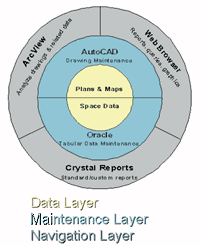 System requirements were incorporated into a Request for Information (RFI) for a new space management system. A selection team comprised of Facility Management personnel and other University staff was assembled. University policy indicated selection of commercial products, with integration as required, rather than creation of custom software. Four vendors were selected to make day-long presentations, using University data (database and drawings), to illustrate the capabilities of their systems to meet the University’s functional and technical requirements.
The following major software components were selected:
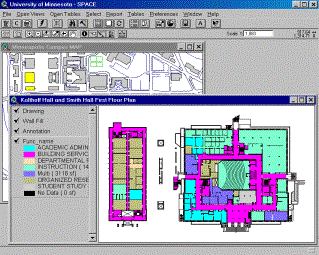
A pilot project was implemented to test the design strategy. A detailed evaluation of the implementation tools was also performed. Strategies for a number of process issues were finalized including the conversion of 60,000 existing database records. Standards to guide the creation of floor plan drawings and campus maps were developed and tested. The initial version of both the Oracle Forms data maintenance and ArcView navigation tools were implemented and usability testing was performed.
A relational data model that met the business requirements of the University was developed along with programs to automatically convert existing data. Processes were developed to incorporate drawings and the graphical navigation requirements of the system. The Oracle data model employed database triggers and procedures (for example, research cannot be conducted in certain types of spaces) to insure data quality compliant with University business rules. The data model incorporated NCES (National Council of Educational Statistics) coding schemes for classification of space.
Business requirements had clearly indicated the need to support simple integration of data from other systems. The concept of "user-defined" or "parochial" data was developed to allow SPACE data to be used in concert with other University systems (such as Classroom Scheduling, Inventory Services, Human Resources, et al.) or departmental databases.
The pilot project tested the full functionality of the system design, limiting the data environment to buildings on one major campus and room level detail for two major facilities. The pilot project concluded with formal presentations and proof of concept. Presentations and hands-on sessions were conducted with users, staff and faculty to test usability. Detailed project plan and budget estimates were developed for the full implementation phase. Based on response to the design and evaluation of the project plans, a determination was made to proceed with full implementation.
Implementation of the full production version of the SPACE system included significant data conversion and creation. Procedures were deployed to automatically convert space management data from the existing mainframe system into the new fully relational data model. More than 1,400 CAD floor plans and five campus maps were developed in accordance with a set of industry compliant standards. Source drawings were reviewed and used when available, occasionally requiring on-site field surveys. Quality control was performed on all data, including drawings that were developed. Data reconciliation was conducted to compare new and old inventory numbers.
Some customization and testing was performed on versions of the navigation, maintenance and reporting software. All software and data components were integrated. Extensive functional and performance tests were performed on all components of the system throughout this phase.
A number of processes were reengineered to facilitate compatibility with other University business activities. Job descriptions were developed or modified and organizational and reporting relationships were redefined. Full documentation was developed for every aspect of the system. Training was conducted for both system users as well as those responsible for maintenance of the system.
The SPACE System was released into full production in two stages. In November 1997, the Oracle database and reporting capabilities were initiated. Drawing supported graphical navigation to approximately 60% of the inventory at that time. This stage also included access to the University's Data Warehouse for reports through the University's Intranet.
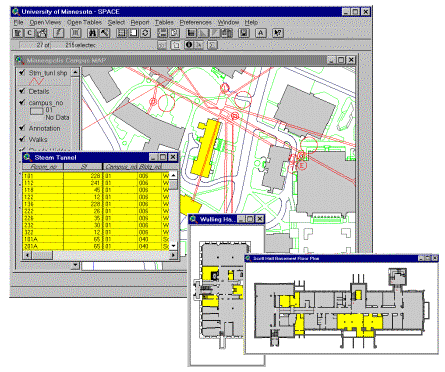 Full implementation was achieved in April 1998, with the completion of the remainder of the drawing data. Activities since full implementation have centered on deployment of the SPACE System across the University. Enterprise-wide deployment carries with it the responsibility to insure that all users get the training and technical support they might need. Questions about SPACE data, password access, training, general use the system, or integration with other University applications are addressed to the Application owner. Questions about connectivity to system and infrastructure/telecommunications support issues are the responsibility of the University’s Office of Information Technology (OIT) that is responsible for desktop support of other enterprise-wide applications.
The role of the Application Owner has also emerged as a key factor in achieving broader use. In addition to overall responsibility for the use and quality of the system, the Application Owner acts as liaison to help other University departments implement the SPACE System to address their own business problems. In one case, Residential Housing merged their database of room assignment characteristics (gender preference, smoking preference, visitation, etc.) with institutional data. The combined data was used to produce drawings used for student registration. Plans call for use of the data to manage custodial contracts, with additional discussion underway to explore web-based student registration.
In another example of enterprise-wide use, the group responsible for facilities maintenance is integrating their new CMMS (Computerized Maintenance Management System) with the SPACE System. By sharing the Oracle tables that describe the location hierarchy, maintenance planners have access to institutional space data to schedule preventative and unplanned maintenance.
The SPACE system consists of Operational System components to support data maintenance and a Data Warehouse implementation to support broad-based access from the University at large.
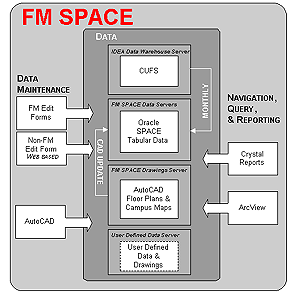
The Operational System consists of several components maintained on equipment in the University’s Facilities Management (FM) Department. This system supports accurate and timely maintenance of data by FM staff and departmental space coordinators. The application owner grants authorization to those maintaining the data in response to churn and programmatic changes. While the Operational System also supports navigation, query and reports, this component is optimized for data maintenance. Information from the Operational System is uploaded weekly to the University’s Data Warehouse where it is accessible to the entire enterprise.
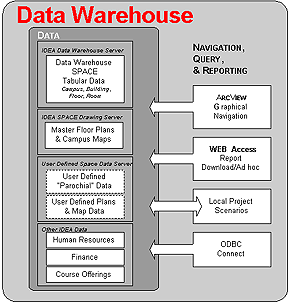
The Data Warehouse component is optimized for graphical navigation, query and reports, not data maintenance. The data at the Data Warehouse represents a weekly "snapshot" of information from the Operational System maintained by FM. Data is uploaded from the Operational System to the Data Warehouse each Sunday evening. The data refresh may replace, remove and add new data to the Data Warehouse. The upload also provides the opportunity to make minor modifications to the data for security and other business reasons. The data then remains static until the next refresh cycle. Data at the Data Warehouse is "read-only," no data maintenance can be performed against the data.
The Data Warehouse is also the repository for other University information including financial, human resources and course offerings. This data, along with other user-defined data which may be stored at the Data Warehouse, or on user-defined servers, can be connected to the SPACE database for analysis and reporting.
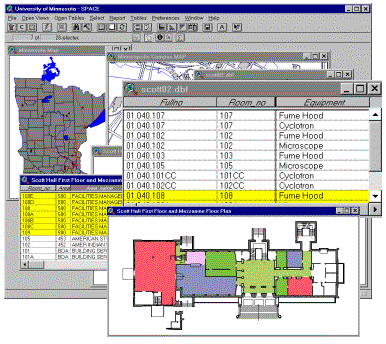 Institutional data includes information about space occupancy, use and other characteristics that is of value to a broad spectrum of the University. Institutional data is the core of the SPACE system. The SPACE System allows users to connect institutional data with other user-defined data. User-defined data is information that departments maintain relative to their unique business requirements such as instructional activities, research projects, controlled substances, and hazardous waste. User-defined data is of primary interest to individual departments for planning purposes and can be analyzed together with institutional data, floor plan drawings and maps. Responsibility for collecting and updating institutional data resides with FM while user-defined data maintenance is the sole responsibility of the individual department. In order to connect user-defined to institutional data for analysis, the data sources must have a common key, such as a spatial reference (e.g., building or unique room number) that matches those used in the SPACE System.
Tabular data in the SPACE System is used for strategic planning and programmatic projections, ad hoc reporting, and to support operational and administrative activities. The data is organized in a spatial hierarchy by: (1) Campus, (2) Zone and/or District (if one exists), (3) Building, (4) Floor, (5) Room, and (6) Room Detail. Most of the information about space is attached to the room and room detail records, but it is possible to capture information about an element at any level of the hierarchy. The room record stores all of the information that is valid for the entire room, i.e. square footage, capacity, ADA accessibility.
The room detail record stores information on the activities of a space including: occupants (departments), NCES/HEGIS (National Council of Educational Statistics, Higher Education General Information Survey) Use and Function Codes, and grants. Information in the spatial hierarchy will identify the user(s) of a space by department, college and provost (Chancellor) / vice president (Vice- Chancellor). Organizational information is linked to information in the spatial hierarchy at the room detail record.
A monthly download from the University’s financial system (CUFS) provides a record of organizational reporting relationships. Procedures have been implemented to automatically incorporate changes to the University’s organizational hierarchy, including a process to resolve any conflicts that may exist as a result of those changes. This approach significantly reduces the data maintenance that results from organizational churn.
Drawing data has been developed for over 1,400 building floor plans and campus maps for Minneapolis, St. Paul, Duluth, Morris and Crookston campuses. Additional building floor plans and campus map will be added as the information becomes available. Campus Maps illustrate major geographic and facility features. Roads, sidewalks and building outlines have been incorporated into the first release of the data. Plans for future releases include the incorporation of utility and other infrastructure data. Floor plans illustrate exterior and interior walls, window locations and door openings. Major structural, circulation elements (stairs, elevators) and mechanical shafts are also noted.
Maintenance of tabular data is accomplished through a set of Oracle Developer 2000 Edit Forms. The forms are designed for easy and intuitive maintenance of the data. Many of the database rules have been embedded in the forms to insure data quality and consistency. Validation lists enforce quality control and are available as drop-down selection lists for data entry. Procedures have been implemented as database rules to prevent erroneous data modification.
Edit Forms have been Web enabled to facilitate churn reporting by staff outside of FM. Departmental and collegiate space coordinators can use a Web form to identify space occupancy and use changes. A limited number of users are authorized to have changes recorded directly in the database. For others, change requests are captured in a separate table for review by FM staff who validate the update requests. Processes define the responsibility of each group, including the method for obtaining access to the data, the security controls that have been implemented, and validation.
Drawing data (floor plans and campus maps) is maintained through the use of AutoCAD. Standards that fully define the information structure of floor plan and campus map data have been developed to guide drawing creation and maintenance. Software has been developed to check the compliance of drawing data with defined standards. Procedures identify the mechanisms for determining when and how drawings should be modified.
Changes to floor plan drawings often cause updates to tabular data as a result of the CAD Import procedures that have been developed. Additions and/or deletions of rooms, as well as changes in room sizes (square footage) are detected by the CAD Import process, which automatically triggers related changes in the Oracle database.
A customized implementation of ArcView (Esri, Redlands, CA) provides the graphical navigation and query interface that links the floor plan and campus map drawings with information in the Oracle database. The same SPACE Navigator software that operates against the Oracle data in the Operational System also works against the Sybase database, which is used for the University’s Data Warehouse.
Using CAD drawings as a navigation method, the SPACE Navigator provides an Executive Information System (EIS) that can be used to "browse" from a state map, to a campus map, to detailed floor plans. Once open, the drawings can be queried for information from the associated portion of the database. Similarly, data attributes can be queried to locate and display specific plans or maps. For example, a campus map provides information about buildings and a floor plan provides information about rooms. Drawings can be color-coded to reflect various values in the database and used as part of reports. Drawings can also be annotated with any values from the database.
Implementing GIS tools for the graphical component of the SPACE System provides the opportunity to integrate user-defined graphical data such as infrastructure data with room level detail. This allows a planner to overlay drawings such as steam tunnel locations, graphically identifying the impact of infrastructure projects on building occupants. For example, the system can locate and highlight building support areas that will be taken out of service when the steam tunnels that service that facility require maintenance.
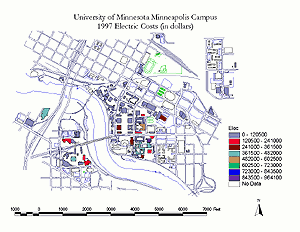 The Finance Department is using SPACE to help analyze the Building Cost Report (BCR) which summarizes utility and other operations costs for University facilities. Once connected to enterprise-wide information, BCR data can be queried to identify buildings, and then the departments and activities in those buildings that have high operating costs. Cheryl Coryea, CFO, Facilities Management, and her department are using the Navigator to create campus maps that are color coded to reflect the costs of different utilities. "We are now able to analyze the information graphically, with more accurate enterprise-wide data. SPACE highlights the managerial financial data that let’s us move quickly into action. In the final analysis, this tool is enhancing our operating efficiency."
User defined data can be connected at any level. The figure illustrates information from Human Resources and Computer Equipment Inventory linked to institutional room level information as part of a strategic planning and move management project. Floor plan drawings can be used as a tool for navigating and reporting to a variety of data.
The Navigator includes a Local Project feature that lets users conduct "what if" scenarios for planning and design on their desktop without modifying the institutional data. If a user elects to save a project data set to their local hard drive, the data for all of the buildings that are active in the project (including all tabular data along with the relevant Campus Maps and Floor plans) are copied down to their system. Users can manipulate the data and the institutional data will not be modified. All of the navigation and reporting capabilities are available for use with the local data set.
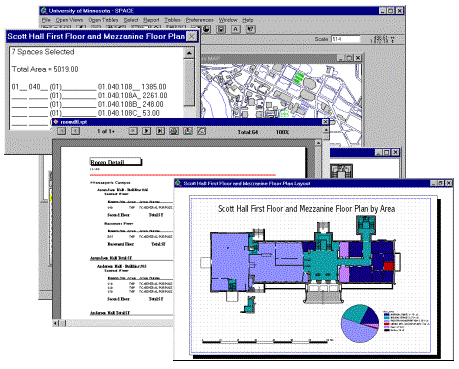 The Navigator software includes a reporting component that produces color drawings, charts and reports at precise scales including architectural engineering size plots. Selections of rooms from Floor Plans and Tables can also be summarized in standard integrated Crystal Reports from the Navigator. Crystal Reports can also be used as a stand-alone for ad hoc queries and standard reports. A suite of more than twenty standard reports have been developed. Both simple and complex reports can be created with Crystal, incorporating graphics if desired. Since the system is fully Windows compliant, all drawings and text objects can be cut and paste into a variety of other programs.
As stewards of the University’s facilities, FM’s responsibility extends to providing data to its customers across the University. New information technologies, like the SPACE System that uses GIS technology, provide accurate, up-to-date drawings and utilization data to support activities of a broad spectrum of users and business processes. Enterprise-wide automation solutions require more collaborative efforts during implementation – they are challenging efforts. However, the delivery mechanisms that result can leverage institutional data, facilitate the flow of information between business functions, and support dynamic integration across departmental boundaries. They are powerful management and analysis systems that are having much broader impact on the efficiency of an organization.

Debra Gondeck-Becker, Assoc. AIA
Project Manager
Jordani Consulting Group
12 South 6th Street, Suite 914
Minneapolis, MN 55402
612.333.9222 phone
612.333.9210 fax
info@jordani.com
www.jordani.com