Kari Mikkonen
Soil and Water Ltd has designed and implemented a Customer and Network Management System (CNMS) for managing information of a water supply network and customers of a water supply company. The system is being used at the Water Supply Company of the city of Hai Phong in Vietnam.
CNMS manages information of water pipes, network devices (valves, pumps, hydrants, meters etc.) and their related information (leaks, maintenance) as well as data of house connections. CNMS connects to a Billing and Receivables System (BARS) for water supply companies, a system made by PricewaterhouseCoopers. Through the BARS connection CNMS also manages information of customers, consumption and billing. CNMS has been implemented using ArcView GIS and SQL Server.
City of Hai Phong is the third largest city in Vietnam. It has some 500.000 inhabitants on the urban area of about 20 square kilometers. The city is divided into 38 phuongs, i.e. administrative sections.
Hai Phong Water Supply and Sanitation Programme started already in 1990. The project is funded by Foreign Ministry of Finland, Department of International Development Cooperation. The objective of the project is to improve water supply and sanitation services in Hai Phong and increase capacities of related public service companies SADCO (sanitation), URENCo (solid waste) and HPWSCo (water supply). Development of a GIS for management of water supply customer and network information started in 1997.
Hai Phong Water Supply Company has 640 employees and is divided into three productive departments. Today the company serves 81.500 customers and 340.000 inhabitants through individual customer connections and 150.000 inhabitants served by public tanks and taps. Water supply is divided into high pressure (65%) and low pressure supply.
A tailored customer information system BARS (Billing and Receivables System) has recently been implemented at HPWSCo by PricewaterhouseCoopers. BARS manages consumption and billing information. BARS runs on SQL Server database on MS Windows NT Local Area Network.
An important reason for implementing the CNMS in Hai Phong has been lack of operative data of consumer connections. Furthermore network and customer connection maps have not been up-to-date. Location of individual water meters has not been known and no condition or maintenance data of the meters has been stored. Implementation of CNMS eliminates these disadvantages.
CNMS can be used for
CNMS server runs in Windows NT environment, the clients run in Windows 95/98 or Windows NT. The database is implemented using Microsoft SQL Server. The GIS interface is based on ArcView GIS 3.1. CNMS is for most part translated into Vietnamese.
Tailored solutions have been designed for storage of network data. The specific need was to enable simultaneous multiuser editing of the data - without big money in the budget for purchasing tools like SDE. All network data is stored in SQL Server tables. Selected themes are loaded from database tables into shape files.
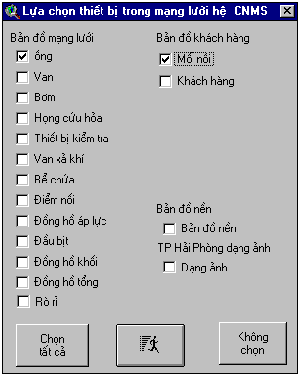
Image 1. This form is used to select themes. CNMS themes (tables) are on the left, BARS themes on the right, on top, and base map themes on the right, below.
The themes are then managed with standard ArcView tools with the exception that all editing operations also update the data directly in the SQL Server tables.
PricewaterhouseCoopers has modified BARS by adding X and Y fields in the tables for consumer and meter data. Digitising and editing operations in CNMS update directly these coordinate fields. CNMS uses the attribute data for symbolisation, queries and analysis.
New SQL Server tables with X and Y fields were established for network point features not present in BARS. These include e.g. valves, pumps, hydrants, end caps, leaks and maintenance.
Polylines describing water pipes are converted to a set of two-point-lines for storage in the SQL Server table for pipes. When loading the pipes from the table CNMS assembles them back to polylines in shape file format. Spatial indexing is computed for the lines. This optimises and speeds up retrieval of data from the database.
The data capture and follow up are managed per phuong. Base map data is managed in shape file format. Network and customer data is stored in SQL Server.
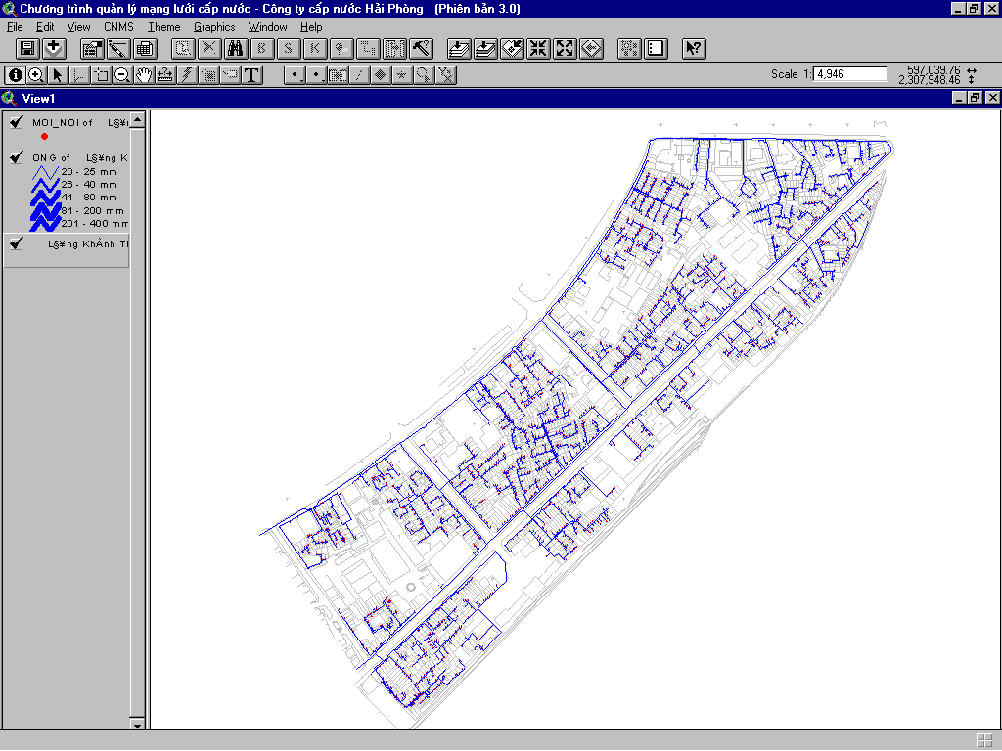
Image 2: Base map, pipes and house connections of one phuong.
A local consultant (Mapping and Investigation Institute of Hai Phong Construction Services) has been contracted to capture base map data. The data has been delivered to HPWSCo in AutoCAD format by phuong and then converted to ArcView shape files. Base map data capture of the last phuong was finished in the summer 1999.
The Technical Department digitises data of pipes using AutoCAD. Specific instructions have been made to ensure correct data and layer structure and connectivity in network nodes. When pipe data of a phuong is ready it is first converted into shape file format and then written into the SQL Server pipe table.
The Network Department uses CNMS to capture data of network devices (valves, end caps, fire hydrants, pressure meters etc.) and maintenance calls or requests. This data capture started in May 1999.
The Consumer Department uses CNMS to digitise master meters, block meters and house connections. A special CNMS tool has been made for building a link to consumer data stored in BARS.
With this special link tool the user selects first a digitised house connection point. Then he points on a text block on the CAD theme. The text block contains customer ID which is used as a key for building the link. The link is built by writing x and y coordinates of the house connection directly in the BARS customer table.
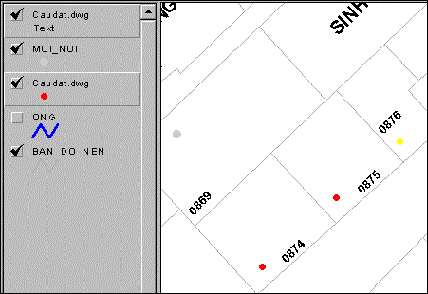
Image 3: Building a house connection link.
For cases when the ID information is not found on the AutoCAD drawing CNMS displays a table of unlinked house connections (i.e. BARS customer records with no coordinates). The user establishes a connection by first selecting a record from the table and then pointing on a pipe end in the view.
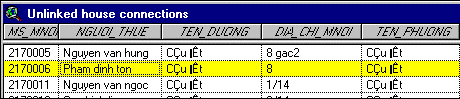
Image 4: Table on unlinked house connections
By summer 1999 house connections in about a fourth of the phuongs have been linked.
Attributes of the network features are used for symbolising themes.
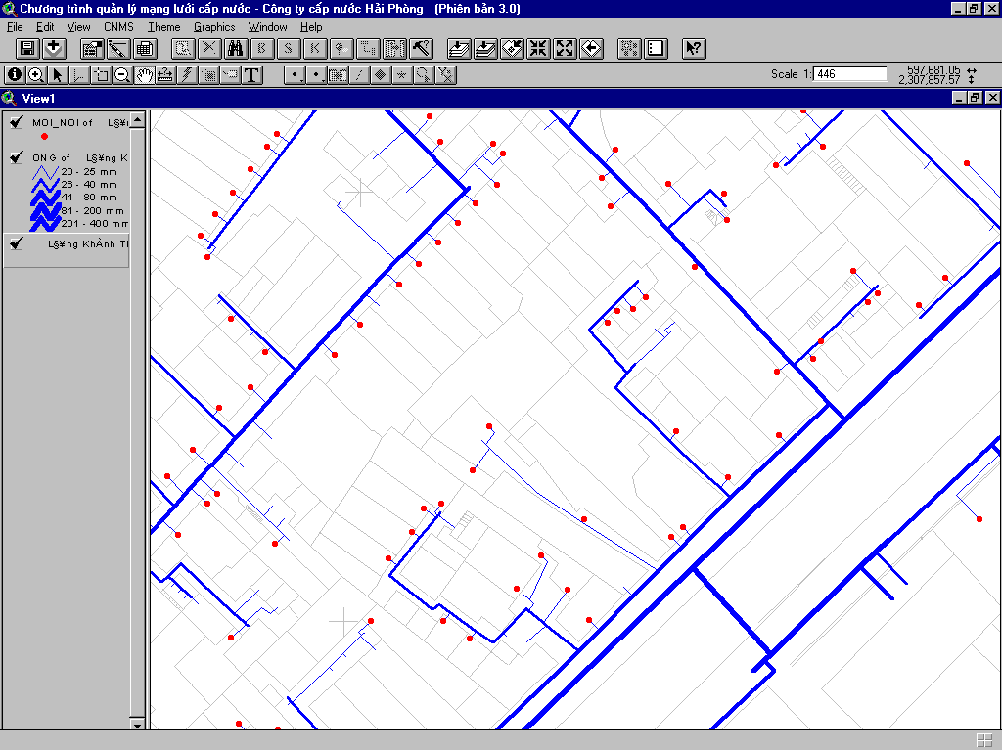
Image 5: Pipes symbolised by size
CNMS recognises three maintenance types:
The network features have associated maintenance records that store information of both performed and planned maintenance. Maintenance logistics can be supported by querying where the planned regular maintenance operations of the next four weeks are located. Displaying all emergency maintenance calls within the past year and symbolising water pipes by age can help to identify problematic parts of the network.
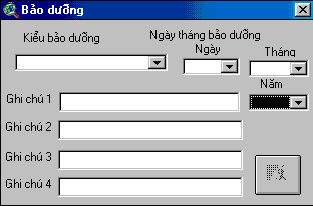
Image 6: Form for storing or editing regular maintenance information
Special themes and routines have been built for visualising BARS customer and billing information. For these themes the user needs to select first the period/month of interest. Also changes in consumption between different months can be visualised.
CNMS can support search of non-revenue water by comparing water consumption of selected period at a selected block meter to the sum of consumption of houses behind the same meter during the same period. The result of the comparison is presented as a thematic map.
Billing and Collections Customer Services Study, HPWSSP Project Report, June 1999
Non-Revenue Water Identification Pilot Programme, HPWSSP Project Report, June 1999
BARS is a trademark by PricewaterhouseCoopers.
The local IT company FPT was subcontracted for ArcView application development.
Kari Mikkonen
Soil and Water Ltd
P.O.Box 50
FIN-01621 Vantaa
FINLAND
Tel: +358-9-682 6647
Fax: +358-9-682 6600
Email: kari.mikkonen@poyry.fi